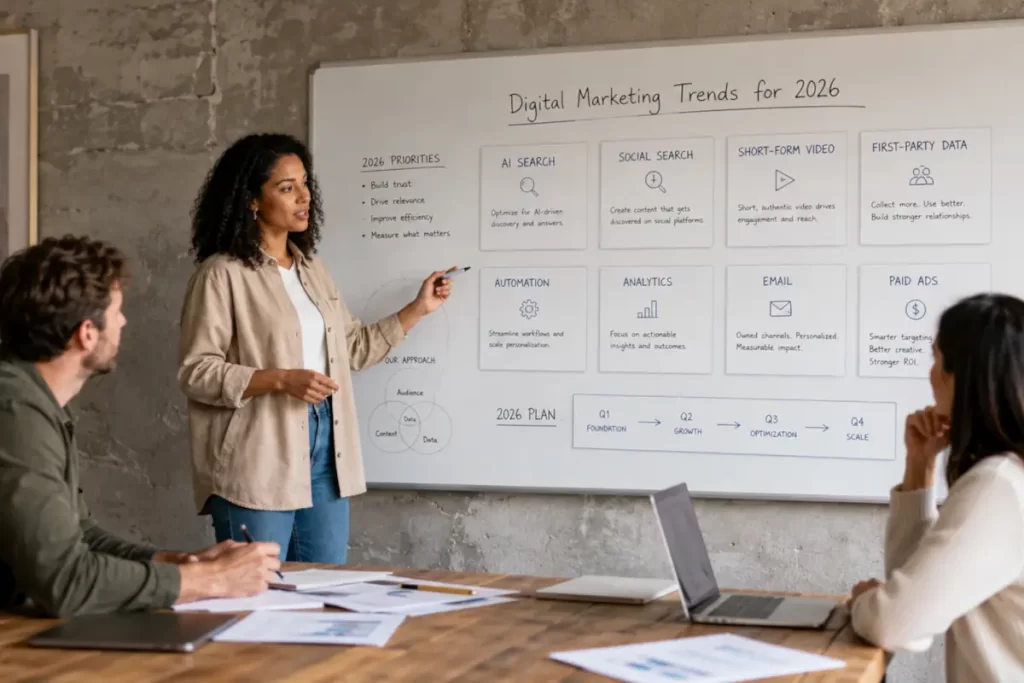
2026 Digital Marketing Trends:
From AI Search to Retail Media, 12 Moves to Make ASAP
Budgets are flat, the channels are not. AI is rewiring search and browsers, retail media keeps compounding, and social search is now a primary behavior for under 30s. Here’s what to do next.
1) AI‑assisted search is the new above the fold
Google’s AI Overviews and “AI mode” features are reshaping how answers appear and how users browse. Publishers are pushing back in the EU and UK, but for marketers the playbook is clear: content worth citing, clear entities, and robust structured data.
Move: Publish answers that deserve citation (original data, “how to”, comparisons) and validate schema. Monitor branded queries for how your content is summarized.
2) Chrome bakes AI into the browser
Gemini features are rolling out in Chrome, normalizing AI assisted browsing for mainstream users. Expect more users to lean on summarize/explain this flows across tabs.
Move: Add TL;DR sections, scannable tables, and FAQs that AI can lift accurately.
3) Budgets are flat; productivity must rise
CMOs report 2025 – 2026 budgets hovering near ~7.7% of revenue. Translation: tighter prioritization, better velocity.
Move: Kill orphan channels; double down where incrementality is proven. Automate ops (QA, tagging, content briefs) but keep humans in the loop for strategy.
4) Retail media & CTV still compounding
IAB forecasts show continued double digit growth in retail media and connected TV, even as macro clouds loom. If you sell on or through retailers, you need a retail media learning agenda.
Move: Stand up 2 – 3 retail media experiments (category keywords, sponsored video, clean room tests) with clear holdouts.
5) Social search is now normal
A rising share of users, especially under 30, search on social and video platforms daily. News and product discovery increasingly start on TikTok/IG/YouTube.
Move: Treat Shorts/Reels/TikTok as search surfaces. Optimize titles, on‑screen captions, and descriptions for “how to…”, “best…”, “vs…”.
6) First party data over thirdparty cookies (for real this time)
Privacy Sandbox timelines have shifted, but regulators and platforms keep tightening tracking. Plan for a world where cookies are unreliable and user choice is foregrounded.
Move: Build consented first‑party data, model gaps, and pressure test measurement without third party cookies. Use platform APIs and server side tagging responsibly.
7) Creator partnerships go B2B
Influencer tactics aren’t just for DTC. Subject matter creators drive reach and trust in niche verticals.
Move: Pilot 3 creator collabs per quarter; measure assisted conversions and search lift.
8) Governance for AI content becomes table stakes
AI can scale content, but governance prevents brand damage and SEO junk.
Move: Publish a public content policy, require sources, and implement human QA. Track fact‑find error rates and update cadences.
9) CRO meets accessibility
Accessibility upgrades (WCAG 2.2) often boost conversions: clearer focus states, bigger targets, better help text.
Move: Add accessibility tasks to every sprint; measure wins (form completion, INP).
10) Performance is a ranking & revenue lever
INP replaced FID. Sites that feel instant win more clicks and sales.
Move: Budget for performance: target LCP ≤ 2.5s, INP < 200 ms, CLS < 0.1 at the 75th percentile. Ship code splitting, image compression, and fewer blocking scripts.
11) Brand search resilience in AI Overviews
Independent publishers are challenging AI Overviews in Europe; visibility is in flux. Brands with strong entity signals and citations remain more resilient.
Move: Strengthen entity markup (Organization, Product, Person), consistent bylines, and reference worthy pages.
12) Measure the right things
Track blended acquisition (search + social search + AI mentions + retail media) and contribution to pipeline, not just last click.
Quick wins checklist
- Add FAQPage or HowTo schema to evergreen guides.
- Publish 2 original data points per quarter (benchmarks, mini surveys).
- Add Shorts/Reels distribution to your editorial calendar.
- Establish retail media test budget with clean holdouts.
- Set performance SLOs (LCP/INP/CLS) and add to your SOWs.
Sources
- Wired — Gemini integrated into Chrome (2025): https://www.wired.com/story/google-gemini-ai-chrome-browser
- Reuters / Guardian — Publisher complaints about AI Overviews: https://www.reuters.com/legal/litigation/googles-ai-overviews-hit-by-eu-antitrust-complaint-independent-publishers-2025-07-04/ and https://www.theguardian.com/technology/2025/oct/16/google-ai-overviews-italian-news-publishers-demand-investigation
- Gartner — 2025 CMO Spend Survey (budgets ≈ 7.7% of revenue): https://www.gartner.com/en/newsroom/press-releases/2025-05-12-gartner-2025-cmo-spend-survey-reveals-marketing-budgets-have-flatlined-at-seven-percent-of-overall-company-revenue
- IAB — 2025 Outlook updates (retail media/CTV/social growth): https://www.iab.com/news/iab-adjusts-2025-outlook-amid-ad-buyers-macroeconomic-concerns-social-retail-media-ctv-will-still-see-double-digit-growth/
- Pew Research — Americans getting news on TikTok (2025): https://www.pewresearch.org/short-reads/2025/09/25/1-in-5-americans-now-regularly-get-news-on-tiktok-up-sharply-from-2020/
- Ofcom — Adults’ Media Use & Attitudes (social & video used for search): https://www.ofcom.org.uk/media-use-and-attitudes/media-habits-adults/adults-media-use-and-attitudes and PDF highlights: https://www.ofcom.org.uk/siteassets/resources/documents/research-and-data/media-literacy-research/adults/adults-media-use-and-attitudes-2025/adults-media-use-and-attitudes-report-2025.pdf
- CMA / Privacy Sandbox status: https://www.gov.uk/cma-cases/investigation-into-googles-privacy-sandbox-browser-changes and https://privacysandbox.com/intl/en_us/open-web/